Azure Local Unleashed: Why We Wrote a Book on the Evolution of Hybrid Infrastructure
There are professional projects that begin with a formal plan, and others that grow gradually from conversations, shared experiences, and a recurring observation.
Azure Local Unleashed belongs to the second category.
Over the past few years, both Silvio Di Benedetto and I have spent a significant amount of time discussing hybrid infrastructure with customers, technology professionals, partners, and conference attendees. These conversations often started from very practical needs: replacing an aging virtualization platform, modernizing a datacenter, supporting workloads in distributed locations, addressing data-residency requirements, or finding a more consistent way to manage infrastructure across cloud and on-premises environments.
During these discussions, Azure Local frequently emerged as a possible answer. At the same time, however, we noticed something important: the platform was still not particularly well known outside a relatively specialized community.
Many organizations were familiar with Azure. Many understood the value of hybrid cloud. Some had already adopted Azure Arc or were exploring alternatives to traditional virtualization platforms. Yet the broader potential of Azure Local was often underestimated or reduced to a narrow definition: a hyperconverged platform, a replacement for an existing cluster, or an infrastructure option for edge scenarios.
In our view, Azure Local has much greater potential.
That realization became one of the main reasons we decided to write this book.
From conversations to a book
The idea behind Azure Local Unleashed was not simply to document a technology. We wanted to help make the platform easier to understand and to explain why it matters in the broader evolution of enterprise infrastructure.
When we spoke with customers, we repeatedly encountered the same questions.
Is hybrid infrastructure only a temporary step toward public cloud? Is Azure Local mainly a virtualization solution? Does it make sense only at the edge? How does it relate to Azure Arc? Can it support application modernization? How should organizations evaluate workload placement? And, perhaps most importantly, how can all these environments be managed without creating new operational silos?
These are not installation questions. They are strategic and architectural questions.
They affect the way organizations plan investments, organize teams, define governance, manage risk, and modernize applications over time. They also show why the conversation around Azure Local cannot be limited to hardware specifications or deployment procedures.
We therefore wanted to create a book that could connect technology with operating models, architectural decisions, and real-world requirements.
Not just another installation manual
Technical guidance is, of course, an important part of the book. Azure Local must be designed, deployed, integrated, and operated correctly. Hardware, storage, networking, identity, security, resilience, and lifecycle management all matter.
But our goal was not to write only a step-by-step installation manual.
There is already a large amount of documentation available for individual technical tasks. What is often harder to find is a complete view of the platform: why an organization should consider it, where it fits, which problems it can solve, and how it changes the way hybrid infrastructure is managed.
For this reason, the book focuses not only on how Azure Local works, but also on the strategy and philosophy behind it.
We explore the idea that cloud is no longer simply a destination. It is increasingly an operating model that can extend across public cloud, customer datacenters, branch offices, factories, remote sites, and other distributed environments.
In this model, workloads do not all need to run in the same place. They should run where they create the most value, according to requirements such as latency, data sovereignty, connectivity, application dependencies, performance, continuity, and cost.
The real challenge is maintaining consistent management and governance while execution remains distributed.
That is where Azure Local becomes particularly relevant.
Hybrid is not a compromise
For a long time, hybrid infrastructure was often described as an intermediate phase: a bridge between the traditional datacenter and an eventual cloud-only future.
Our experience suggests a different reality.
Some applications are natural candidates for public cloud services. Others need to remain close to users, machines, business systems, or regulated data. Some can be modernized quickly, while others will continue to depend on virtual machines for many years. Some require cloud elasticity; others benefit from predictable, locally owned capacity.
This does not mean that modernization has failed. It means that modernization should not be confused with relocation.
An application can continue to run on-premises while adopting cloud operating principles. It can be governed through policy, monitored centrally, protected through a common security model, and managed through repeatable automation.
Hybrid infrastructure becomes valuable when these capabilities can be applied consistently across different locations.
This is also why we see Azure Local as more than a virtualization platform. Virtual machines remain extremely important, but the broader opportunity is to create an Azure-consistent execution layer within customer-controlled environments.
Starting from real-world needs
One of the themes we wanted to emphasize in the book is that infrastructure modernization rarely begins from a blank page.
It often starts with a very concrete event: hardware reaching the end of its lifecycle, rising virtualization costs, a new regulatory requirement, the opening of a production facility, a business continuity initiative, or the need to modernize an application without moving its data.
A hardware refresh, for example, is a completely valid starting point for adopting Azure Local.
Replacing aging servers can address capacity, performance, supportability, and operational risk. But the refresh can also become an opportunity to ask a broader question: should we simply replace the existing infrastructure, or should we also improve the way it is managed?
This distinction matters.
New hardware alone does not eliminate fragmented monitoring, inconsistent security controls, manual update processes, or site-specific procedures. Without a broader operating model, organizations risk recreating the same silos on a newer platform.
Azure Local offers the possibility of connecting infrastructure replacement with wider modernization: cloud-consistent management, centralized governance, security, observability, automation, and support for both existing and modern workloads.
What readers will find in the book
The book follows a progressive journey, moving from the foundations of hybrid infrastructure to the strategic directions that are shaping its future.
We begin by examining the evolution of hybrid cloud and the role of Microsoft’s Adaptive Cloud approach. We discuss cloud sovereignty, regulatory requirements, and the reasons why organizations increasingly need infrastructure that can combine local control with a consistent cloud operating model.
From there, we move into architecture and planning. We explore the key elements that influence an Azure Local design, including compute, storage, networking, resilience, security, and integration with the wider Azure ecosystem.
The book also covers deployment and operations, but always in connection with the broader objective: building an environment that can be managed and governed over time, not simply brought online.
A dedicated part of the book examines how Azure Arc extends management, governance, security, monitoring, and policy across distributed resources. This is central to the overall message. Workloads may execute locally, but they should not become isolated from a common control model.
We also explore different modernization paths. Existing applications may continue to run as virtual machines, while newer services can adopt Kubernetes-based architectures. Azure Virtual Desktop can support scenarios where application proximity or data locality matters. AI and data-intensive workloads can also be placed closer to the source when latency, continuity, or sovereignty make local execution the better option.
Another important section focuses on real-world scenarios and the competitive landscape. We wanted to connect architectural principles with the decisions organizations are actually facing, particularly as many reconsider their long-term virtualization and hybrid infrastructure strategies.
Finally, we look at the future: the evolution of Azure Local, the growing importance of distributed infrastructure, and the role that AI-enabled operations and intelligent edge scenarios may play in the years ahead.
Who the book is for
We wrote Azure Local Unleashed for a broad professional audience.
Infrastructure architects will find guidance for positioning Azure Local within wider hybrid designs. Platform engineers and system administrators will find practical insights into deployment, operations, governance, and lifecycle management. Consultants can use the book to structure conversations with customers and evaluate different modernization paths.
IT leaders and decision-makers will find a strategic perspective on workload placement, sovereignty, risk, and investment protection.
The book does not assume that every reader is already an Azure Local expert. It is designed to accompany the reader from the strategic context to the architectural and operational considerations that shape real projects.
At the same time, we hope that experienced professionals will recognize many of the challenges discussed in the book and find useful perspectives for addressing them.
A challenging and rewarding journey
Writing a book is a very different experience from delivering a conference session, publishing a technical article, or working on a customer project.
It requires time, discipline, continuous review, and the willingness to revisit concepts until they are both accurate and understandable. It forces you to move beyond what you know intuitively and explain why certain decisions matter.
This was a challenging project, but also an extremely rewarding one.
Silvio and I have known each other for many years, and this book reflects our shared passion for technology, architecture, and knowledge sharing. It also brings together different experiences developed through customer engagements, community activities, conferences, and many discussions with professionals working on hybrid infrastructure every day.
For both of us, sharing knowledge has always been more than a side activity. We see it as an essential part of our professional work.
Technology changes constantly. Products evolve, architectures mature, and new requirements emerge. The ability to understand these changes is important, but so is the ability to explain them, make them accessible, and translate them into real value for organizations and people.
Our hope for Azure Local Unleashed
Our hope is that this book will help more professionals understand the real scope of Azure Local.
Not only how to deploy it, but why it exists.
Not only how to run virtual machines, but how to build a more consistent hybrid operating model.
Not only how to replace infrastructure, but how to use that moment as the beginning of a broader modernization journey.
Most importantly, we hope the book encourages readers to look at hybrid infrastructure not as a compromise between cloud and on-premises, but as a deliberate architectural model.
A model in which workloads can run where they make the most sense, while management, governance, security, and lifecycle control remain consistent.
A special thank you goes to Thomas for contributing the Foreword and sharing his perspective with our readers. We are also grateful to BPB Publications for believing in the project and supporting us throughout the entire journey.
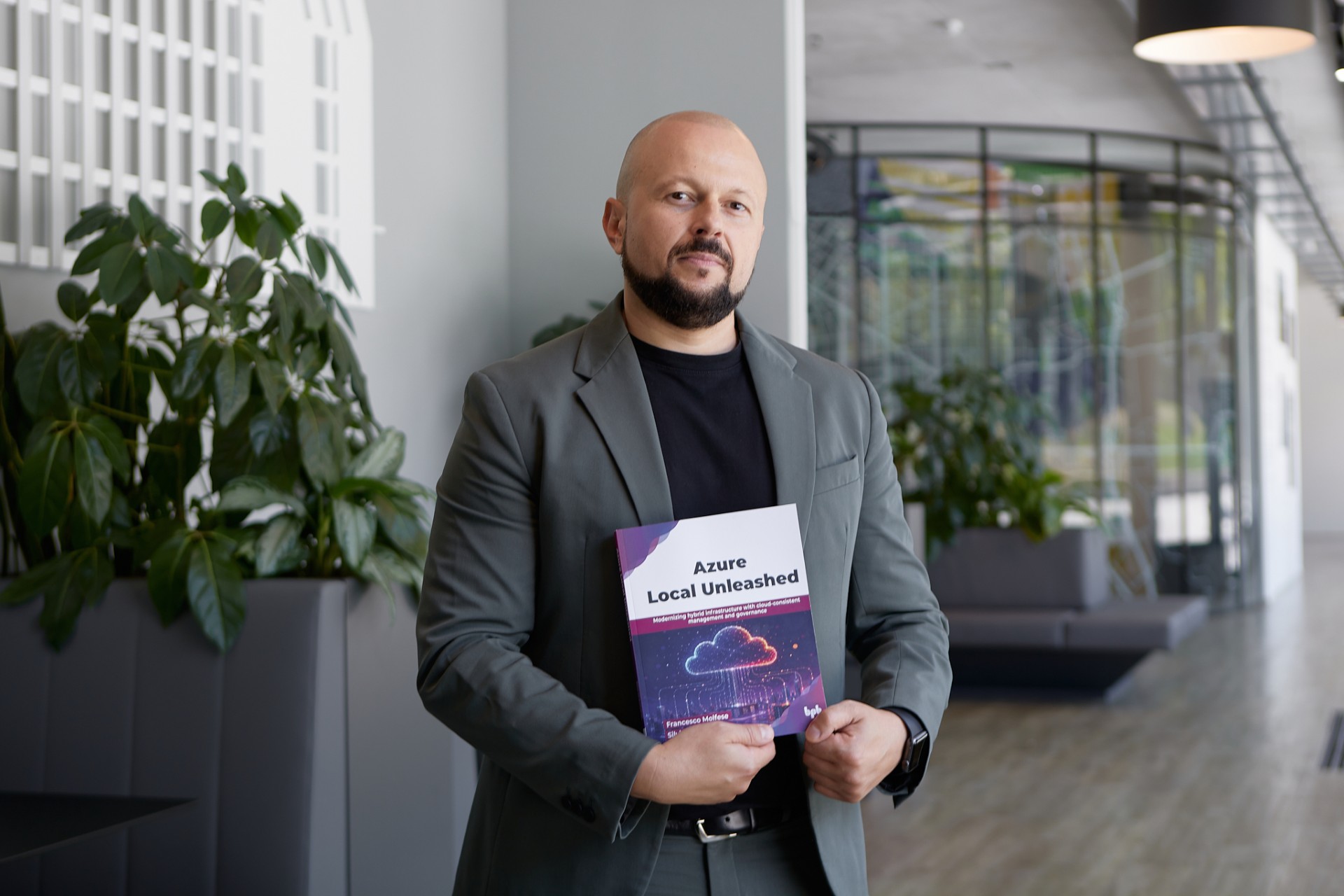
Azure Local Unleashed: Modernizing Hybrid Infrastructure with Cloud-Consistent Management and Governance is now available.
We hope you enjoy reading it as much as we enjoyed writing it.